
Age Spots
Flat, darkened skin patches from sun exposure. At Pinnacle Dermatology, our dermatologists provide accurate diagnosis and effective treatment options.
Treatment availability varies by Pinnacle Dermatology location. Please contact your clinic to confirm.


Flat, darkened skin patches from sun exposure. At Pinnacle Dermatology, our dermatologists provide accurate diagnosis and effective treatment options.
Treatment availability varies by Pinnacle Dermatology location. Please contact your clinic to confirm.
Understanding and Treating Age Spots
Age spots, also known as liver spots or solar lentigines, commonly develop on areas of the skin that receive frequent sun exposure. These areas include the face, hands, neck, exposed scalp, and arms. Prolonged exposure to ultraviolet (UV) rays from the sun or tanning beds accelerates the production of melanin, the pigment responsible for skin color, leading to the formation of these dark spots.
While age spots are typically harmless and a natural part of the aging process, their appearance can sometimes resemble that of cancerous growths. This similarity can cause concern, as distinguishing between benign age spots and malignant lesions is not always straightforward. Some age spots may have irregular borders, varying colors, or change over time, mimicking the characteristics of skin cancer, particularly melanoma.
To accurately differentiate between benign age spots and potentially cancerous lesions, it is essential to consult with a qualified dermatology provider. At Pinnacle Dermatology, our experienced dermatologists are trained to identify various skin conditions, ensuring a precise diagnosis. During a thorough skin examination, our providers will assess the size, shape, color, and texture of the spots. If there is any doubt, they may perform a biopsy, which involves taking a small sample of the skin for further analysis under a microscope.
At Pinnacle Dermatology, we prioritize personalized care and patient education. During your appointment, our providers will discuss your specific concerns and goals, recommending the most suitable treatment plan for your age spots. We are committed to helping you achieve healthy, radiant skin and peace of mind.
Schedule an appointment with one of our Pinnacle Dermatology providers to explore your treatment options for age spots and ensure your skin's health and beauty are well-maintained.
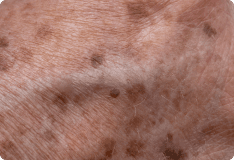
Examples of Age Spots


Symptoms of Age Spots
Flat, Oval Shapes: Age spots are flat, oval-shaped areas of skin with no raised texture.
Brown, Gray, or Black Color: Often appear in shades of brown, gray, or black.
Small to Medium Size: Age spots can range in size from small to medium.
Common Areas: They frequently occur on sun-exposed areas such as the face, hands, shoulders, and arms.
Causes of Age Spots
Age spots are more likely to appear on people whose lifestyle exposes them to the sun.
Over time, the skin loses its ability to repair itself after sun exposure and the spots appear.
Preventing Age Spots
The best way to prevent age spots is to keep the skin from becoming overexposed to the sun by covering it with clothing or using a broad-spectrum, high-SPF sunscreen. You can work with our skin experts to determine the best course of skincare specific to your skin and individual needs.
Treatments for Age Spots
There is no medical need to treat age spots; however, the proper diagnosis should be made by a dermatology provider since some skin cancers have similar appearances. Healthy, glowing skin is our goal and our skin experts are available to create a custom treatment plan that matches your skin goals. If one opts to treat age or sun spots, there are cosmetic options, including:
Laser Therapy: Lasers can target pigment in age spots, breaking it down and allowing the body to naturally eliminate the discolored cells.
Chemical Peels: A chemical solution is applied to the skin, causing it to peel and new, evenly pigmented skin to replace the old skin.
Microdermabrasion: This procedure involves gently exfoliating the outer layer of skin, which can help reduce the appearance of age spots.